
Hong Kong – Agilis Robotics Limited is pleased to announce the publication of the first-in-human trial of robotic-assisted transurethral en bloc resection of bladder tumours (ERBT) using the Agilis Robotics Intilume™ System in European Urology, the official journal of the prestigious European Association of Urology and the leading journal in the field of Urology & Nephrology.
The paper, “Robotic-assisted Transurethral En Bloc Resection of Bladder Tumours Using the Intilume Robotic System: First-in-human Experience,” is available now on
- PubMed at https://pubmed.ncbi.nlm.nih.gov/42509104/ and
- via DOI https://doi.org/10.1016/j.eururo.2026.04.006.

Figure 1 (left): Publication of the first-in-human results of Agilis Robotics’ Intilume™ system for robotic-assisted ERBT in European Urology, a prestigious endorsement of the system’s academic value and potential clinical impact.
Figure 2 (right): Front cover of European Urology, the official flagship journal of the European Association of Urology (EAU).
The Clinical Problem
En bloc resection of bladder tumours has been shown to enable accurate pathological staging and to reduce short-term recurrence. Its wider adoption, as the authors set out, is held back by technical difficulty and by the learning curve, particularly for larger tumours, for difficult locations such as the bladder dome and anterior wall, and for less experienced surgeons.
The constraint is one of access. The transurethral route offers a narrow entry and a confined workspace. Conventional rigid instrumentation gives the surgeon no straightforward way to retract tissue while resecting, and the authors note that no commercial robotic systems with two flexible arms are currently available for this procedure.
Our Intilume™ System as Used in the Trial
The Intilume™ System is a miniaturised platform designed for transurethral procedures. Its flexible robotic instruments are accommodated through a customised inner sheath that can be fitted to a standard 26 French (~8.67 mm diameter) rigid cystoscope sheath with a standard 4-mm telescope, with the assembly held and stabilised by an integrated endoscope holder.
Following docking of the robotic instruments and positioning of the cystoscope sheath, the surgeon is seated at a control chair and operates two pen controllers. These manipulate two ultra-thin flexible robotic arms, 3.2-mm in diameter, fitted for ERBT with a bipolar hook and a tissue grasper. Diathermy cutting and coagulation are controlled from one controller, and grasper opening and closing from the other.
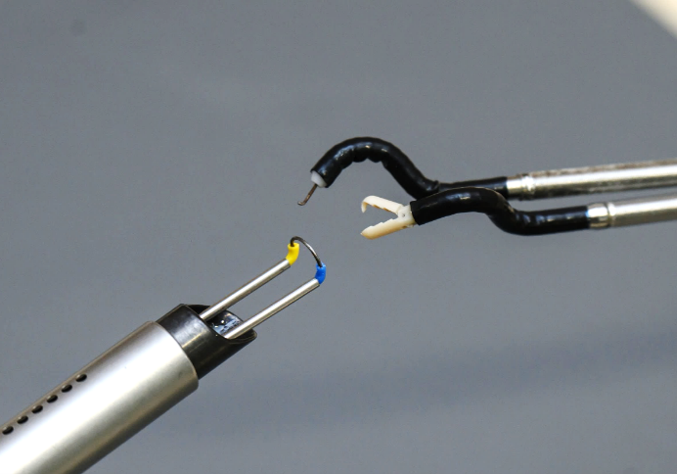
Figure 3: Side-by-side size comparison of the conventional bipolar loop resectoscope (left) and Agilis Robotics’ custom-designed, ultra-thin 3.2 mm flexible robotic instruments (right), equipped with a bipolar hook and tissue grasper specifically for en bloc resection of bladder tumours (ERBT). The instruments are driven by pen-style controllers.
Image credit: © Agilis Robotics.
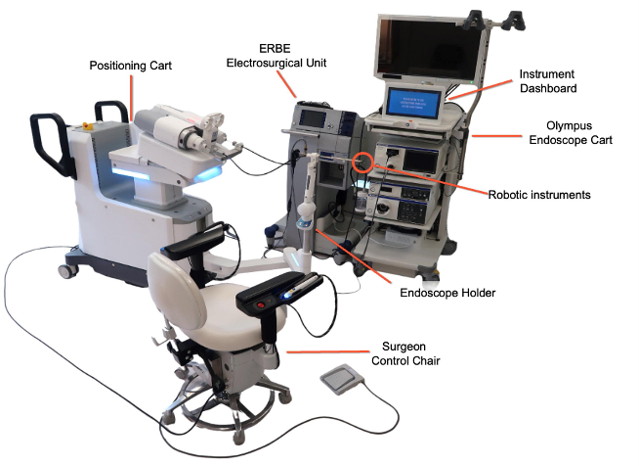
Figure 4: Intilume™ system surgical setup. Shown are the Patient Positioning Cart, Endoscope Holder, and Surgeon Control Chair equipped with Pen Controllers, which drive the two flexible Robotic Instruments. The system integrates with a conventional endoscopy and electrosurgical unit. Real-time system and instrument information is provided by the Instrument Dashboard.
Image credit: © Agilis Robotics.
What the Trial Reported
Eleven consecutive patients underwent robotic ERBT between December 2024 and May 2025, with 13 tumours selected for robotic resection. Robotic-assisted ERBT was successfully completed on 11 tumours across 9 patients.
Tumours were successfully resected from various anatomical locations, including the anterior wall, posterior wall, both lateral walls, the dome, and the bladder neck. Across these procedures, the median tumour size was 1.0 cm (IQR: 0.6–2.0), and the median dissection time—from first incision to completion of submucosal dissection—was 31 minutes (IQR: 12–44). Crucially, there were no intraoperative bladder perforations.
What the Authors Observed
The authors set out three advantages. First, the decoupled flexible bimanual design allowed effective tissue counter-traction and exposure of surgical planes in a way that is not possible with a traditional resectoscope. In all lateral wall cases, no obturator jerks were observed, which the authors suggest may relate to medial retraction of the bladder wall away from the obturator nerve. Second, the controls were more intuitive and the learning curve appeared more manageable, with improved ergonomics at difficult sites such as the anterior wall and dome. Third, the compact and portable design, together with compatibility with existing rigid cystoscopic elements, reduces barriers to adoption.
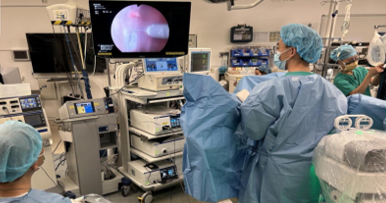
Figure 5: The primary surgeon operates from the control chair, while an assistant can fine-tune the positioning of the cart and endoscope holder. Image credit: © Agilis Robotics.
What this Means for Agilis Robotics
Founded in 2021, Agilis Robotics set out to build endoluminal surgical robots that provide enhanced dexterity while remaining compatible with standard equipment and workflows hospitals already have. The transurethral route was chosen deliberately as the most constrained setting in which to test that proposition.
These results formed the clinical foundation for our continuing regulatory submissions and for broader clinical evaluation across further indications, including the gastrointestinal tract, where the same flexible instrument architecture and the same principle of compatibility with standard endoscopes apply. Our mission remains unchanged: to empower surgeons with a more intuitive system to treat cancers – all without any external incisions.
We extend our gratitude to the clinical and research team at CUHK, whose expertise and dedication made this first-in-human study possible.
About Agilis Robotics Limited
Agilis Robotics aims to transform incisionless endoluminal surgery with ultra-thin, flexible robotic instruments engineered to enhance surgical precision and simplify learning. Founded in 2021 Hong Kong, Agilis Robotics has since scaled its operations by establishing a dedicated production base in Guangzhou (PRC) to drive the manufacturing of its innovative systems. Designed to integrate seamlessly with standard endoscopes, our versatile robotic system, the Intilume™ System, empowers clinicians with advanced dexterity and adaptability when managing early-stage cancers and diseases—unlocking new possibilities for more accessible and effective care.
Disclaimer: The Intilume™ System is not approved for sale or commercial use in any market. This document is for informational purposes only and does not constitute medical advice.